
An ambitious peatland restoration project is helping to revive Lancashire’s moorlands, improve water quality and make the landscape more resilient to climate change.
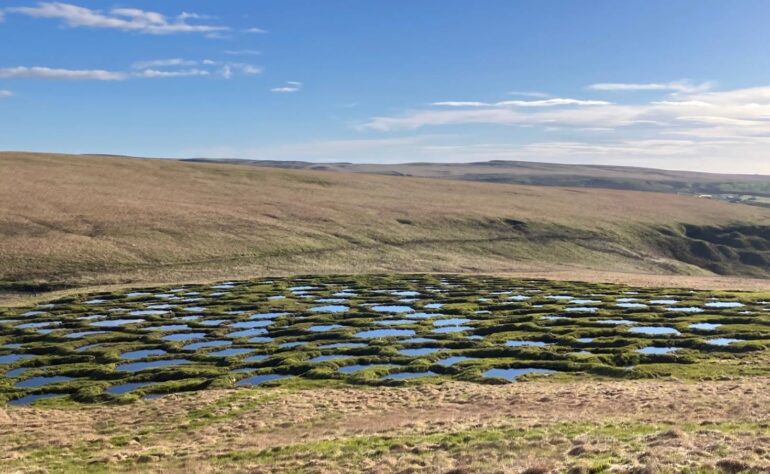
Thousands of small dams have been built across Winter Hill in Lancashire to restore damaged peatland and encourage the return of wildlife, eight years after wildfire swept across the moorland.
Around 4,000 crescent-shaped dams have been installed across an area equivalent to 550 football pitches, helping to retain rainwater, restore blanket bog habitats and slow the flow of water into rivers and reservoirs below.
The project, funded by United Utilities and delivered in partnership with the Lancashire Peat Partnership, is taking place within the company’s Rivington catchment, on land badly affected by the 2018 wildfires.
Despite this year’s hot summer the dams have continued to hold water, allowing new vegetation to establish and wildlife to return. Curlews and lapwings, previously absent from the restored areas, have been recorded alongside increasing numbers of dragonflies, grasshoppers and other insects.
The restoration works by reversing the drying out of the peatland, which can release stored carbon, contribute to erosion and leave moorland habitats more vulnerable to drought and wildfire.
Healthy blanket bogs act as natural water filters, trapping sediment and helping to improve the quality of water entering streams and reservoirs. By retaining rainfall for longer, they can also help moderate downstream water flows and contribute to natural flood management.
Pete Wilson, Catchment Partnership Officer at United Utilities, said in a press release by the water company that the early results were encouraging, particularly the recovery of vegetation and the ability of the dams to retain water during dry weather.
The project is also intended to improve the landscape’s resilience to future wildfires, although conservationists emphasise that rewetting must be accompanied by other measures, including managing excessive vegetation through cutting and conservation grazing.
Alex Hubberstey, Lancashire Peat Partnership manager at Lancashire Wildlife Trust, said the return of nesting birds was particularly welcome, with the dams providing fresh water, feeding opportunities and shelter.
Winter Hill lies within the wider West Pennine Moors, a landscape protected by Site of Special Scientific Interest (SSSI), Special Area of Conservation (SAC) and Special Protection Area (SPA) designations due to its ecological importance.
The area is also the focus of an innovative Landscape Recovery project involving United Utilities and Lancashire Wildlife Trust and supported by DEFRA, which aims to restore nature across almost 7,000 hectares of mixed habitat in the West Pennines.
The work comes amid an unprecedented programme of environmental investment by Britain’s water industry in catchment management.
During the current five-year Asset Management Period, running from 2025 to 2030, water companies are making record levels of investment in sustainable catchment management and nature-based solutions, recognising the benefits of restoring habitats for water quality, flood risk management, carbon storage and biodiversity recovery.
United Utilities has already restored around 3,000 hectares of peatland since 2020 and plans to restore a further 4,000 hectares by 2030.
Image credit: About Manchester